One of the most beautiful moments for me when I became a mother was when my daughter Jessica started talking. Physically, she is petite, that is, she is slightly smaller than girls her age.
During my pregnancy I had read several articles, and I remembered some that referred to how to start talking to babies. The recommendation was to speak to them in complete sentences, making eye contact, and above all, with love. The articles mentioned the importance of doing so, as it said that parents model what communication will be for them.
Since Jessica was tiny, she looked even smaller for her age. I decided to follow the recommendations of the articles I read, and I talked to my daughter almost all the time she was awake. When she started to say her first words, my heart melted. No one could understand what she wanted to say, but she imitated the articulation of my voice. On top of that, since she looked even smaller for her age, the cuteness was even greater.
When she was old enough, “everything” was hers. She started referring only to her toys:
-Mine, mine, mine, mine.
And then to the furniture in our apartment, until she got to everything she saw on the street. Everything was “her” property.
Have you ever wanted to define what is yours? Have you ever had to point out what is your property?
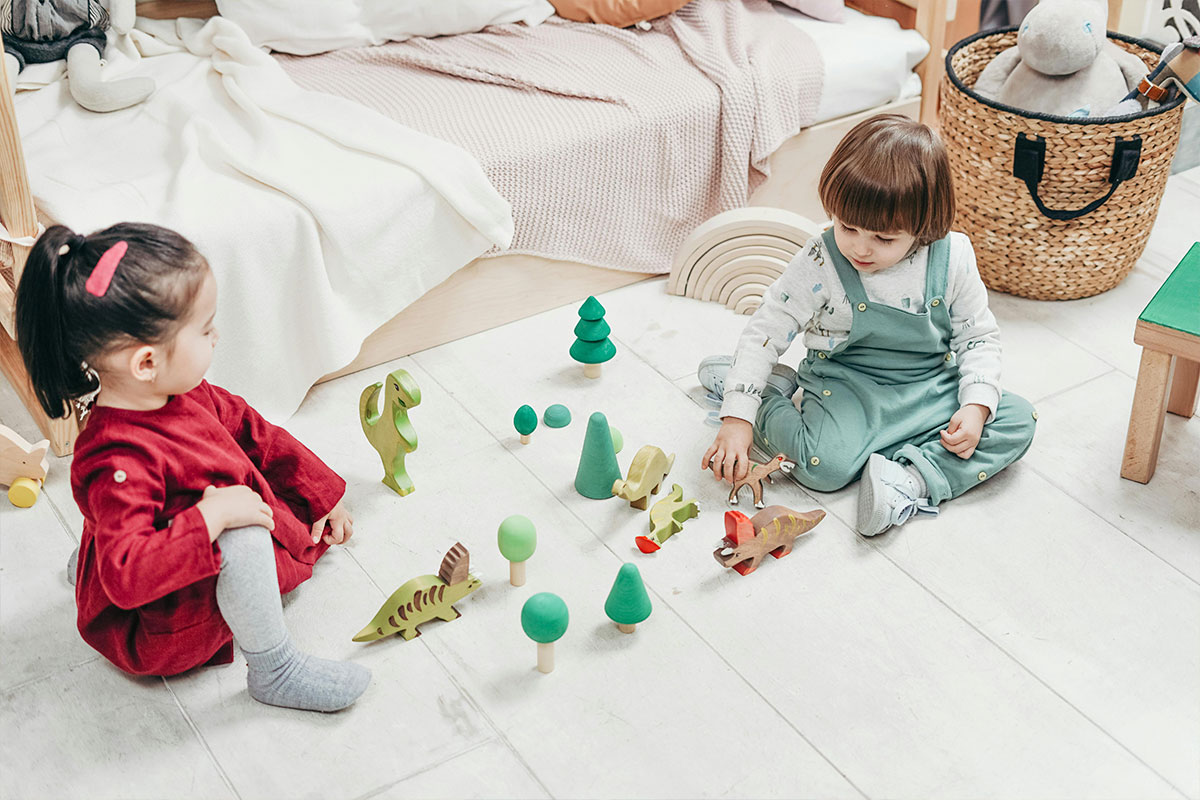
These declarations of ownership seemed cute to me, until it came to playing with her cousin, who is a year older than her. That’s when the difficulties began, because Jessica wanted to have her cousin’s toys.
No matter how much I spoke to her in complete sentences, looking her in the eyes and trying to explain that not all those toys were hers, I was not really successful in getting her to understand me. What helped a lot was that her cousin was always very generous, and he lent her everything. When we returned home, I tried to distract her with something else so she wouldn’t try to bring “her” toys.
Her declarations of ownership continued, everything “was still hers.” Later I realized that all children go through that stage in their development.
I didn’t know how to handle the moments with her cousin, because her insistence that everything was hers continued. And I knew that it wasn’t about correcting her, but rather guiding her. It was a matter of finding the right way to cope.
Until one day, something occurred to me.
I was getting ready to comb her hair, and Jessica had the comb in her hand. I asked her if I could borrow it. Her response?
-Mine!
To which I replied
-Yes, and mine too.
And Jessica gave me the comb.
Ahhh!
From then on, every time she said:
-Mine!
I replied that it was also someone else’s.
–
If it was a book, and she said,
-Mine!
I would reply,
-Yes, and mine too.
If it was a plate or cup from the kitchen, and she said:
-Mine!
I would reply,
-Yes, and mine too.
If it was a car on the street, and she said:
-Mine!
I would reply,
-Yes, and the driver’s too.
If it was a toy belonging to his cousin, and she said:
-Mine!
I would reply,
-Yes, and your cousin’s too.
In your experience, how much of what is yours do you consider to be your own? Would you share it?
There was a time when Jesus observed a widow giving everything from the little she had as an offering, contrasting with the example of others giving from what they had left over. Here it seems that Jesus is referring to the willingness to give, offer and share, and not necessarily to the amount of their offerings. My nephew, older than my daughter, was more mature in understanding that he could share, and my sister-in-law explained to him that Jessica was younger.
In your case, how easy or difficult is it for you to share what you have?
When it came to things she saw outside the house, Jessica gradually came to understand that things were hers, and others’ as well.
Can you share your resources, time, and attention?
I had a conversation with a friend, who told me:
-Do you know what you have when you have nothing? Freedom.
It seems that the widow that Jesus saw was free enough to give what she had. Or as Jesus says, from her poverty.
Could poverty lead us to freedom?
God does not force us to do anything, but invites us to give, to share, to be generous, as God is.
If the Spirit inspires you, share with Jesus the carpenter how you can cultivate your generosity, to give freely. And perhaps you can say, “it’s mine, and my neighbor’s too.”
Marisol
P.S. We can hear about giving from poverty in the readings of the XXXII Sunday of Ordinary Time, year/cycle B.