
There was a phrase that I heard very often in my adolescence and youth: “Where is Vicente going? “Where all the people go.” And that phrase was almost always accompanied by some criticism of some masses of people for following some public figure without apparent common sense.
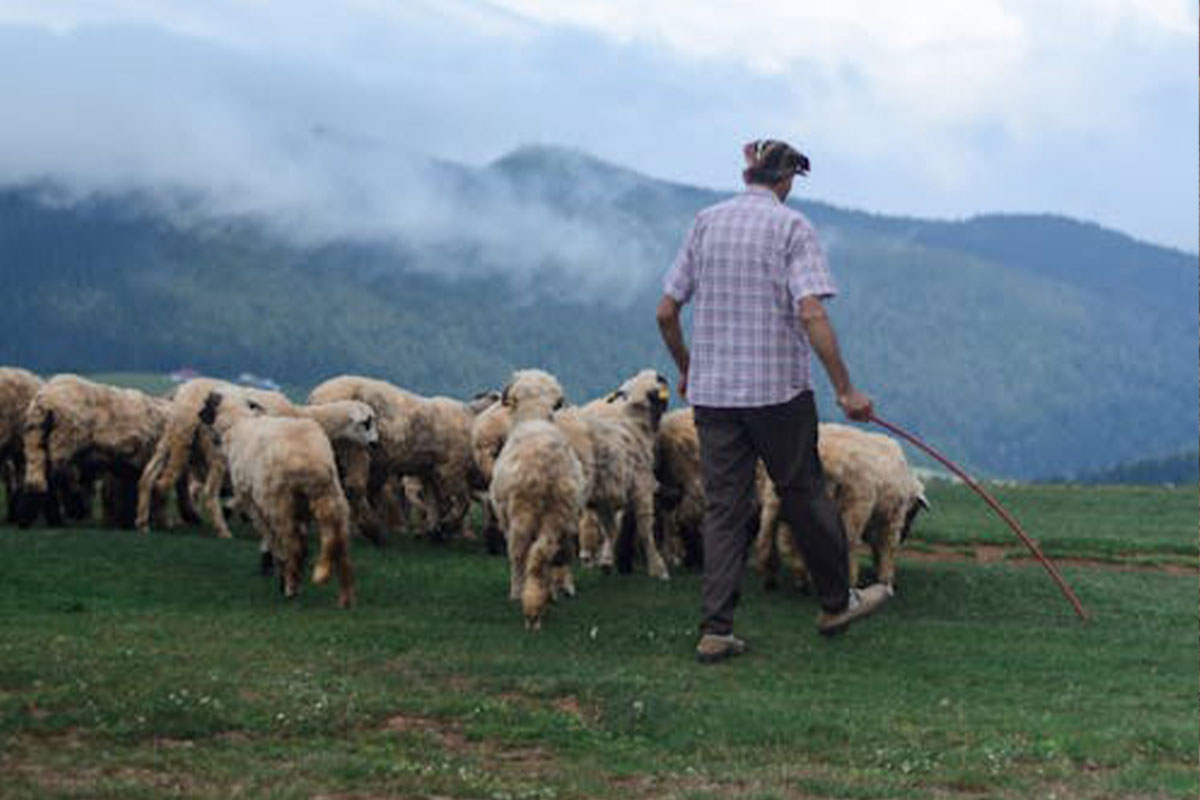
On other occasions the phrase was followed by comparing the mass of people with a group of sheep, that did not matter where they went, as long as they followed that leader of unclear intentions.
Since I had not had the experience of being in a field where there were sheep, I never had direct reference to their actual behavior. What was common was the derogatory stance towards that behavior.
I never questioned it, I just listened to it. But without realizing it, as time went by I adopted it.
Have you ever heard anything similar?
And then I became conflicted. Since the connotation of a herd of sheep was negative for me, hearing that Jesus presented himself as the good shepherd did not add up. It was not about Jesus, but about the sheep.
For me there was no problem in identifying “the bad leader” from the “good leader.” But there was something I couldn’t directly identify about the herd of sheep, that when they followed the “bad leader” they were the subject of fair and apparently deserved criticism, and among the group of sheep that followed the “good leader.” What was the difference? The behavior of the pack was exactly the same, to follow the leader.
This was a question that never kept me up at night. Until one time, I went to a ranch, where they had a variety of animals, including goats and sheeps. My daughters were little, and they were looking forward to seeing and possibly feeding some animals.
For my daughters, the animals they were most attracted to feeding were the little ones, a couple of goats, one was black, and the other almost white. They had their bells hanging around their necks, and they were always close to their mother.
When the owners approached, they told my daughters how to approach the goats from the fence, and they told them how to offer them food. So that they would come closer. My daughters were attentive, and did as they were taught, happy and waiting for the goats to approach. But when the owners moved, the goats’ attention went completely to them, regardless of whether my daughters had anything for them.
Over the course of the day, it was evident that the sheep had the same behavior towards their owners. If they moved, the sheep followed, no matter who was offering them anything.
It was then that I was able to not only see, but experience the trust and bond of those little animals to their owners. Time, care, guidance, food, affection, was the minimum that had been given to all the animals from their owners. The fact that my daughters or I had something to give them was not enough, not even for them to turn to see us.
What is it that you and I trust? Or, put another way, who do you and I trust?
For those little animals to trust, they didn’t have to hear a message to convince them to trust. They have trusted because they know that they are cared for, they know it. They know.
What do each of us know that guides us to trust God?
Jesus is mentioned several times as a teacher, but on this occasion Jesus refers to himself as “The Good Shepherd,” and not as “teacher.”
Could it be because it is not just about understanding? Could it be because it is also about trusting and following him?
I invite you to take a short pause and take a deep breath.
Pay attention to your interior.
Without judging, what do you notice arising in you?
Pause, and breathe again.
The little animals on the ranch did not need convincing to follow those who have given them care, food and love for so long.
What does that say to each one of us regarding our stance toward a deeper following of God?
Do I look for God to convince me with the best arguments for my doubts?
If you would like to trust God in a deeper way, you can ask Jesus to teach you, he has experience. He is the Lamb of God.
And then you can adapt Vicente’s phrase: “Where am I going? Where Jesus is going.”
Marisol
P.S. We can listen how did Jesus introduced himself as the Good Shepherd in the readings off the IV Sunday of Easter, year / cycle B.